This page describes Mac Japanese-English dictionary software. (If you have not enabled Japanese input on your computer, visit the first page of this site first to find out how.) The full site contents is as follows:
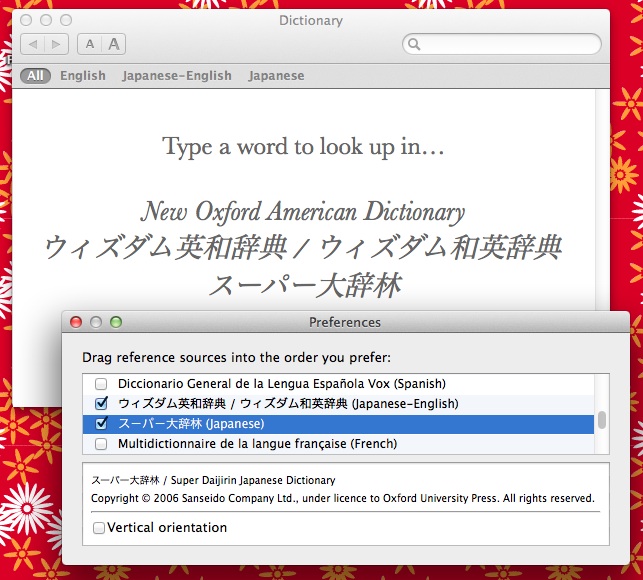
Mac OS 10.5 (Leopard) comes with a dictionary application (called simply "Dictionary."). In addition to an English dictionary, it includes several Japanese dictionary files: a large Japanese dictionary, a usage dictionary that distinguishes usage for similar words, an English-Japanese, and Japanese-English dictionary. (These are Daijisen, Ruigo reikai jiten, and Progressive waei eiwa chûjiten, all published by Shôgakukan.) If you can read enough Japanese to use all three of these (the first two are Japanese only), then this is a formidable combination.
The Japanese dictionaries are not activated by default; to enable them, you must open the Dictionary application, then open its preferences from the file menu and check the dictionaries you want to use.
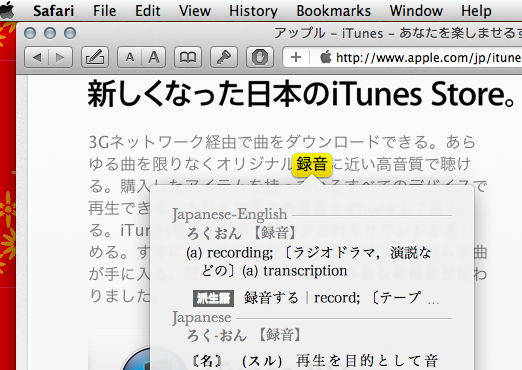
Dictionary also has an elegant pop-up window that displays definitions from within other applications. See Using the the Dictionaries from Within Other Programs below, for details.
If you use this a lot, you may have a use for LookUpDictionary, a clever little utility that automatically copies the clipboard or selection into the Dictionary application, to make repeated look-ups more convenient.
goo is web portal in Japan with a popular dictionary server that incorporates several large dictionaries, including the Daijirin Japanese dictionary and the EXCEED J/E and E/J dictionaries (all published by Sanseidô). You can use this dictionary server by pointing your browser to the goo dictionary web page, or through an application that accesses the server. Examples of the latter include:
Many of the other Japanese dictionary programs available online use the same core dictionary file, originally called EDICT. This is the result of a project led by Jim Breen, to construct a digital public-domain Japanese-English and Kanji reference dictionary. The dictionary has a number of features useful to Japanese language learners, and several specialized sub-dictionaries for things like kanji, names, and technical vocabulary. A later version of the dictionary in a more modern format is called JMDICT. There is more information about EDICT and JMDICT below, but you don't need to know all those details to get started with the software that uses the dictionary.
You can sample the contents of EDICT/JMDICT at its web-interface, WWWJDIC Page, which lets you look up individual words or generate a vocab list for a longer text or a whole web page. See also the other web translation sites discussed on my browsers page, most of which seem to use some varient of the JMDICT dictionary.
This page discusses dictionary software based on JMDICTor similar dictionary files, that lets you access them more quickly or when you are offline. Most of these programs also have features that let you invoke them from inside your web browser, text editor, etc. (more on that below). The programs I think are most powerful and promising are the first four.
I would recommend one of the programs above, but there are also a few other options that may work for you if you need other features.
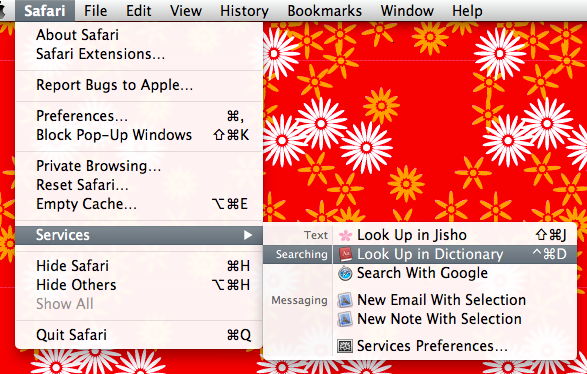
Most of the dictionaries above have some features that allow them to be called from within other applications, like word processing programs, web browsers, or email clients. Often this is through the Services menu, which appears in all applications (look under the first application menu item just to the right of the apple menu, and you should see "Services" about halfway down). After you install a program like Jisho, for example, will find an item "Look up in Jisho" has been added to the services menu. When you highlight a word on web page in Safari, for example, and select this item from Services (or press its keyboard shortcut, command-shift-J), Jisho will open and display the definition. This may work more reliably in some applications than in others; if it does not work in Firefox, for example, try Safari.
Apple's dictionary program can also be activated from within other applications this way. If you set the Dictionary application's preferences so that the contextual menu activates a "dictionary pane" (one of the few options in Dictionary's simple preferences) then the definitions will appear in a stylish (if tiny) pop-up window right in your application. This has a keyboard shortcut as well: (command-control-D), and you can even hold this combination down and mouse over multiple words.
One problem is that the initial keyboard shortcuts assigned to these services sometimes conflict with existing shortcuts, so they don't work. Fix this by reassigning the shortcut for the service: first, open "Preferences," select the "Keyboard and Mouse" preferences, click on the "Keyboard Shortcuts" pane, and add a new shortcut using the "+" button at the bottom. On the drop-down sheet, choose "all applications" from the pop-up menu, type the name of the services menu item you want to change, like "Look Up in Tensai," or "Look Up in Jisho," then enter a new keyboard shortcut. Quit and restart your applications to make the new shortcut available to them. (Thanks to Tensai developer Justin Anderson for this tip.)
Begun in the early days of the web, and long before the explosion of wikis and other collaborative editing projects, EDICT was a project to construct a public Japanese-English dictionary from user contributions Over the years it has grown to a point where it can compete with many paper dictionaries in terms of accuracy and completeness, and is still being expanded and updated by its creators and users. EDICT is now a subset of the Japanese Multilingual Dictionary (JMDICT), which is a larger dictionary file in a more modern format (Unicode XML) and with additional information. For example, JMDICT contains not only English equivalents of Japanese words, but also equivalents in other Western languages.
Information about the dictionary files is available on developer Jim Breen's EDICT Page and his JMDict page. These pages includes links to download the dictionaries, which are stored on the ftp archive at Monash University. Jim Breen's descriptions of how everything fits together are rather brief, so I've provided some explanation below. The links in [brackets] will download the file directly from the Monash archive.
Most of the programs above come with a copy of the dictionary file. You can also download the dictionary using the links below, which point to files on the Monash FTP archive. You can also use these links if you want to get the most recent copy of the dictionary, which is updated every few months, and there are some other specialized technical dictionaries as well. But be forewarned that not all the programs above let you update or add dictionary files by yourself in this way.
Back to Christopher Bolton's Home Page